80+
The number of countries moving forward with standardized climate disclosure requirements.

86%
The percentage of Canada’s largest trading partners that already require climate disclosure data.

81.8%
The percentage of global sustainable investment funds underweighting Canadian investment. Representing an estimated $44 billion in lost potential equity.
Canada paused work on its key mandatory climate disclosure (MCD) requirements in 2025, shortly after the U.S. Federal Government signalled a retreat from sustainable investment initiatives.
One year later, as Canada intensifies efforts to diversify trade ties and attract foreign capital, Canada’s pause on mandatory climate disclosures appears to be putting Canadian companies at a competitive disadvantage.
The rest of the world has not paused. A supermajority of OECD countries, plus most G20 economies, now require mandatory climate disclosure or will by 2028 — 44% of global market capitalization, rising to 78% excluding the U.S. Thirteen of Canada’s fifteen largest trading partners already require climate disclosure data, and sit directly in the path of Canada’s target to increase non-U.S. exports by $300 billion by 2035.1
Canadian companies are already fielding climate disclosure requests from both domestic and international counterparties, and these demands are set to increase in both volume and detail.
Canadian exporters, in particular, receive climate reporting requests through several channels: financed-emissions reporting, foreign Scope 3 requests, European due-diligence laws, and carbon border pricing.
Each channel defaults to punitive assumptions when verified data is missing, charging Canada’s cleanest producers, hydro-powered aluminum chief among them, as though they were the most carbon-intensive in the world unless otherwise demonstrated.
Investors — both domestic and international — have voiced strong support for access to reliable, comparable, decision-useful climate data. Without it, we don’t just shelter high-risk firms from investor scrutiny; we also obscure high-performing companies that would otherwise attract sustainable investment capital. The effect shows up in the numbers: as of Q1 2026, Canadian companies were underweighted by international sustainable mutual funds and ETFs by an estimated $44 billion. As Canada’s federal government moves forward with a multi-billion dollar incentive package to stimulate investments in our green economy, our lack of climate disclosure rules may deter precisely the investors we hope to attract.
Consistent national standards with clear regulatory guidelines and well-defined safe harbours can also help allay concerns that environmental disclosures could run afoul of Canada’s anti-greenwashing rules, as they would encourage the disclosure of specific, verified data points while avoiding poorly defined buzzwords.
Recommendation: With investor demand, international precedent and Canada’s own trade-diversification goals aligned, Canadian lawmakers and regulators should require companies incorporated in Canada and/or listed on Canadian stock exchanges to report in accordance with the internationally-aligned disclosure framework prepared by the Canadian Sustainability Standards Board (CSSB). The competitive risk is no longer in moving forward; it is in standing still.

Op-Ed
Why Canada needs to turn toward Europe on climate disclosure
This op-ed was originally published in Le Devoir on Oct. 28, 2026. Le français est inclus.
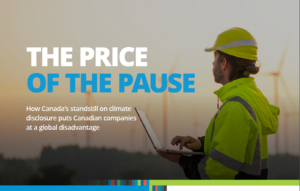
Canada is turning toward Europe, and our market rules should turn with it. In our new report, The Price of the Pause, SHARE argues that if Canada doesn’t move forward with climate disclosure rules, we risk falling out of step with a growing global consensus.

Related Content
Mandatory Climate Disclosures: Myths vs. Facts
If Canada moves forward with mandatory corporate climate disclosures, what will it mean for smaller issuers? Do we run the risk of becoming more or less competitive? Will we be seen as too strict compared to other jurisdictions? Or will we actually be keeping pace? Prepared with the Institute for Sustainable Finance (ISF) this document counters climate disclosure myths to reassure and inform securities regulators, policy makers, investors and issuers.


Written By:
SHARE
Looking to interview a SHARE staff or board member for an upcoming article or report? Send us an email at comms@share.ca to get in touch.
More By This AuthorRelated Reading
View more responsible investing resources and research.

In the News
October 28, 2026
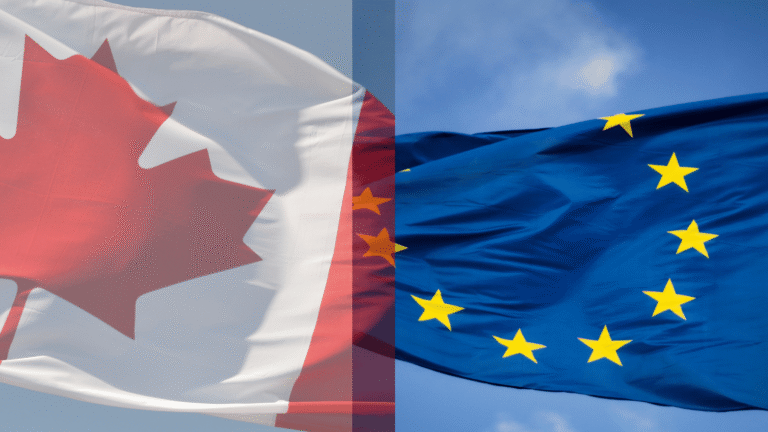
Op-ed: Canada followed Washington on climate disclosure. Now it should turn toward Europe, all the way
This op-ed was originally published in Le Devoir on Oct. 28, 2026.
Read More